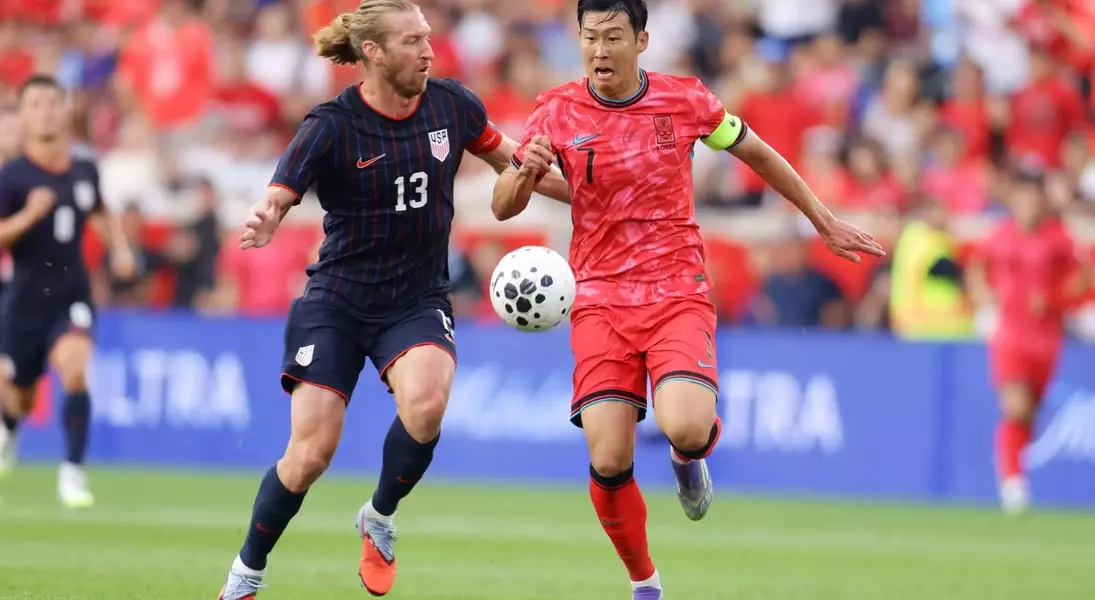
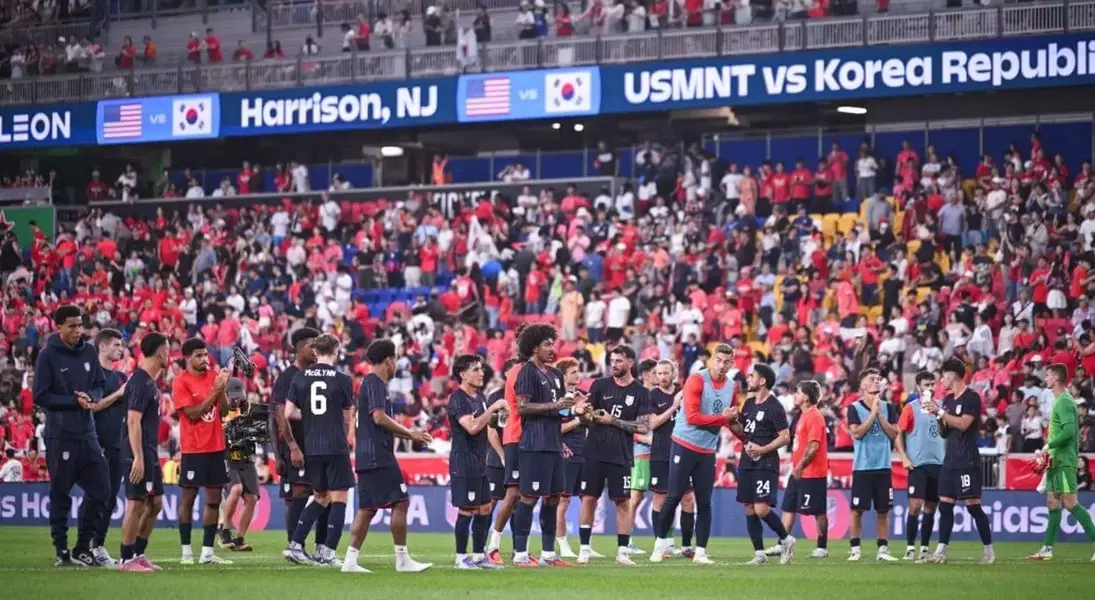
In a striking display of passion and dedication, a recent international friendly match between the U.S. Men's National Team (USMNT) and South Korea in Harrison, New Jersey, unfolded with an atmosphere distinctly favoring the visiting side. Despite the fixture being a designated home game for the USMNT, the stadium was predominantly filled with ardent Korean supporters, transforming the event into what felt like an away fixture for the American squad. This unique dynamic, where the home team struggles to secure a vocal majority in its own stadium, marks a continuing trend for the USMNT, raising questions about fan engagement and the team's appeal as they prepare for the upcoming World Cup.
On a humid Saturday evening in September 2025, at Sports Illustrated Stadium, the USMNT suffered a 2-0 defeat to South Korea. Following the final whistle, USMNT player Tyler Adams was seen surveying the stands, which, despite the American team's 'home' status, were still brimming with cheering Korean fans. These supporters, many of whom were also American citizens, remained to celebrate only one team: the Korean national squad. South Korea's head coach, Hong Myung-bo, notably remarked through an interpreter that the match felt like a 'home match' for his team, underscoring the powerful impact of their fan base.
This phenomenon is not isolated but rather part of a broader global pattern. Over the past three years, the USMNT has frequently found itself playing in environments where opposing fans outnumber their own on home soil. This has been observed against teams from various continents, including Morocco in Cincinnati, Colombia in Maryland, Turkey in Connecticut, Guatemala in St. Louis, and consistently against Mexico, wherever they play. The recent encounter with South Korea in New Jersey further exemplifies this trend.
The Korean contingent at the match brought an electric energy to the stadium, characterized by enthusiastic chants, inflatable boom sticks, waving flags, and palpable joy. Their collective fervor easily eclipsed a smaller section of USMNT supporters, whose attempts to rally a rhythmic clap were quickly drowned out by the dominant Korean cheers. Many Korean fans were clad in red t-shirts bearing the name 'Korea' in both English and Korean, alongside national team jerseys featuring stars like Son Heung-min and Park Ji-sung. Jerseys from European clubs such as Tottenham Hotspur, LAFC, Bayern Munich, Napoli, Wolves, and PSG, showcasing players like Son, Kim Min-jae, Hwang Hee-chan, and Lee Kang-in, were also prominently visible.
While occasional Christian Pulisic jerseys dotted the sea of red, an estimated 75 to 80 percent of the 26,500 attendees appeared to have little interest in the USMNT. The Korean players were met with roaring approval during warm-ups, bowing in acknowledgment to all sides of the arena, and the chant 'Dae-han-min-guk' reverberated throughout the stadium. These passionate supporters occupied every section, from the upper deck to the expensive seats behind the benches, representing families, friends, and individuals of all ages. Although some attendees displayed split allegiances—like one fan wearing a U.S. kit with a Korean flag—their cheers overwhelmingly favored South Korea once the game commenced.
When questioned about the fan turnout, USMNT head coach Mauricio Pochettino adopted a positive tone, thanking the fans present and acknowledging their amazing support, a shift from previous remarks where he might have emphasized the need for more passion from U.S. fans. This change in sentiment perhaps reflects an understanding that reversing this trend requires improved team performance and a more compelling narrative. While the diverse immigrant communities in the U.S. will always gravitate towards their native countries' teams as a connection to their heritage, the current USMNT's uninspiring play and a monotonous path toward the World Cup have undoubtedly contributed to fan apathy.
The atmosphere inside the stadium during the match mirrored the team's performance; a U.S. hype video failed to ignite any excitement, and the USMNT's soccer was equally lackluster. In stark contrast, Korea launched a continuous stream of attacks, eliciting an eruption of cheers with each foray. The crowd roared when Son scored the opening goal and again when Lee Dong-gyeong doubled the lead, maintaining a vibrant noise throughout the night. After the final whistle, the Korean fans lingered for minutes, capturing photos and videos as their team conducted a lap of honor, acknowledging their supporters with claps and bows. Meanwhile, the outnumbered and defeated U.S. players retreated to their locker room, far from the excitement of a World Cup-ready atmosphere.
