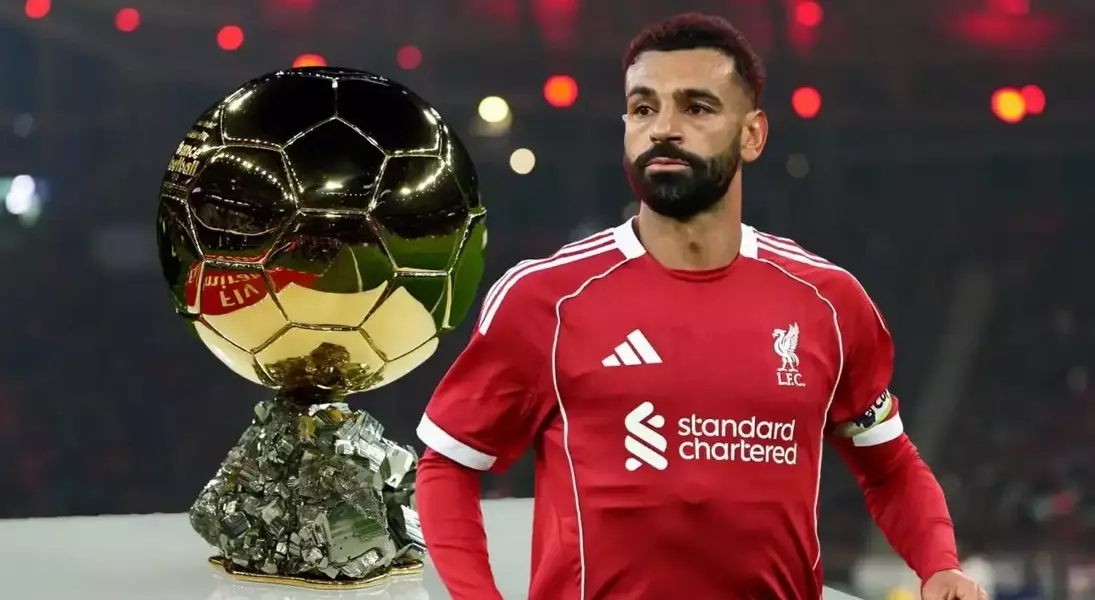
Mohamed Salah's recent fourth-place finish in the Ballon d'Or has ignited a passionate discussion within the football community regarding the criteria for such prestigious accolades and the perceived fairness of the voting process. This debate extends beyond mere statistics, touching upon the influence of team triumphs and the recognition of talent from diverse footballing backgrounds. While individual brilliance is undeniable, the path to the top honor appears to be inextricably linked to the highest echelons of club and international success.
The Ballon d'Or Conundrum: Unpacking Mohamed Salah's Ranking
On a recent Monday, Liverpool's prolific forward, Mohamed Salah, secured the fourth position in the highly coveted Ballon d'Or awards. This outcome prompted considerable commentary from various figures in the football world. Notably, Egypt's national team coach, Hossam Hassan, and Salah's former teammate, ex-Tottenham striker Mido, vocalized their belief that the time had come for a more equitable assessment in football. They implicitly urged the 100 journalists responsible for casting their votes to consider Salah's contributions more favorably, suggesting that fairness should be a paramount factor in determining the recipient of the golden ball.
However, the Ballon d'Or's established framework relies on three fundamental pillars: individual player performance, collective team achievements, and fair play. While Salah's extraordinary season with Liverpool, marked by a Premier League title, 29 goals, and 18 assists, showcased immense individual prowess, it was ultimately deemed insufficient. His campaign for the award reportedly faltered after Liverpool's exit from the Champions League, where they were defeated by Paris Saint-Germain in the Round of 16, with Salah failing to score in those crucial matches. The prevailing sentiment is that the primary architect of the Champions League-winning team is typically the one who claims the top individual prize. This pattern held true once more, with Ousmane Dembele receiving the honor, followed by Lamine Yamal in second, and PSG's Vitinha in third, placing Salah just outside the top three.
Looking ahead to 2026, the narrative suggests that Salah could truly challenge the perceived biases of football journalists. Should he replicate his incredible goal-scoring and assist records for Liverpool, coupled with another Premier League championship and, crucially, a Champions League triumph, his claim for the Ballon d'Or would become undeniably strong. The article also brings to light comments from Jamie Carragher, who in February, speculated on Salah's Ballon d'Or prospects, stating that his association with the Egyptian national team and the perceived lower likelihood of winning a major international tournament like the Africa Cup of Nations might hinder his chances. Carragher's Euro-centric viewpoint sparked a strong reaction on social media, with many calling for a broader perspective on footballing excellence. The hope remains for Salah to continue his stellar form, potentially leading Egypt to an Africa Cup of Nations victory, thereby adding another compelling layer to his already impressive resume and further challenging the established norms of award selection.
The discourse surrounding Mohamed Salah's Ballon d'Or placement serves as a powerful reminder of the intricate balance between individual brilliance and collective success in football. It prompts reflection on the criteria for prestigious awards and whether they adequately capture the global impact of players from diverse footballing landscapes. Ultimately, it emphasizes that while individual talent shines brightly, consistent high-level performance in the most significant team competitions remains the clearest path to ultimate recognition, sparking a broader conversation about equity and opportunity within the sport's highest honors.
