



Football analytics is entering a new era with the advent of skeletal tracking technology. This advanced method, which records the biomechanics of players by mapping their key joints in 3D, offers an unprecedented level of detail compared to traditional tracking data. From enhancing the precision of offside calls to creating immersive fan experiences and providing in-depth performance analysis for coaches and players, skeletal tracking is poised to revolutionize how the sport is understood and enjoyed. This technology, already implemented in major football leagues, signifies a significant leap forward in sports data.
In recent years, the landscape of football analytics has undergone a dramatic transformation. What once relied on rudimentary event metrics like shots and passes has evolved into a sophisticated field utilizing granular data. The introduction of GPS vests for players, for instance, became standard practice, allowing clubs to monitor speed, distance, accelerations, and decelerations during training and matches. This 'traditional' tracking data provided vital insights into player movements and their contributions both on and off the ball, generating thousands, if not millions, of data points per game.
Skeletal tracking elevates this data granularity exponentially, producing hundreds of millions of data points per match. This technology meticulously records the biomechanics of a player's body, mapping 29 key joints, including shoulders, hips, elbows, knees, ankles, head, and eyes, to construct a detailed three-dimensional representation of their pose. While this technology has long been a staple in film production and video games for realistic movement capture, and adopted by baseball and basketball since the 2010s, its application in football is relatively new.
The implementation of skeletal tracking typically involves installing up to 30 specialized in-stadium cameras. These cameras capture player movements at an ultra-high frame rate, significantly more precise than the 25 frames per second offered by traditional tracking methods, achieving up to 100 frames per second. This enhanced precision has been crucial for FIFA and UEFA's semi-automated offside technology (SAOT). By combining accurate body pose information with precise ball-tracking data, SAOT aims to make offside decisions more objective and accurate. The technology made its debut at the 2022 World Cup in Qatar and has since been adopted in prestigious competitions such as the Champions League, Serie A, La Liga, and is set to be introduced in the Premier League from April 2025.
Genius Sports, a leading sports and technology company, serves as the official tracking provider for the Premier League through its Second Spectrum technology. They have been collecting skeletal data in England's top division since October 2022. Interestingly, rather than utilizing expensive, heavy-duty cameras, Genius Sports employs off-the-shelf iPhones, encased in waterproof housings, strategically positioned within each stadium. These iPhones work in conjunction to track all player movements with remarkable accuracy.
Matt Fleckenstein, Chief Product Officer at Genius Sports, elaborates on the advancements: 'Previously, we had center-of-mass tracking where we had one tag on a person. You roughly knew where the player was on the pitch, and how fast they were running and what direction — but you really couldn’t extrapolate the information out further.' He explains that with 30 different views constantly capturing data, the system can triangulate information from multiple camera angles, enabling real-time 3D recreations of player movements. This allows for a much finer level of detail, such as the 'end-of-toenail' precision required for semi-assisted offside technology in the Premier League.
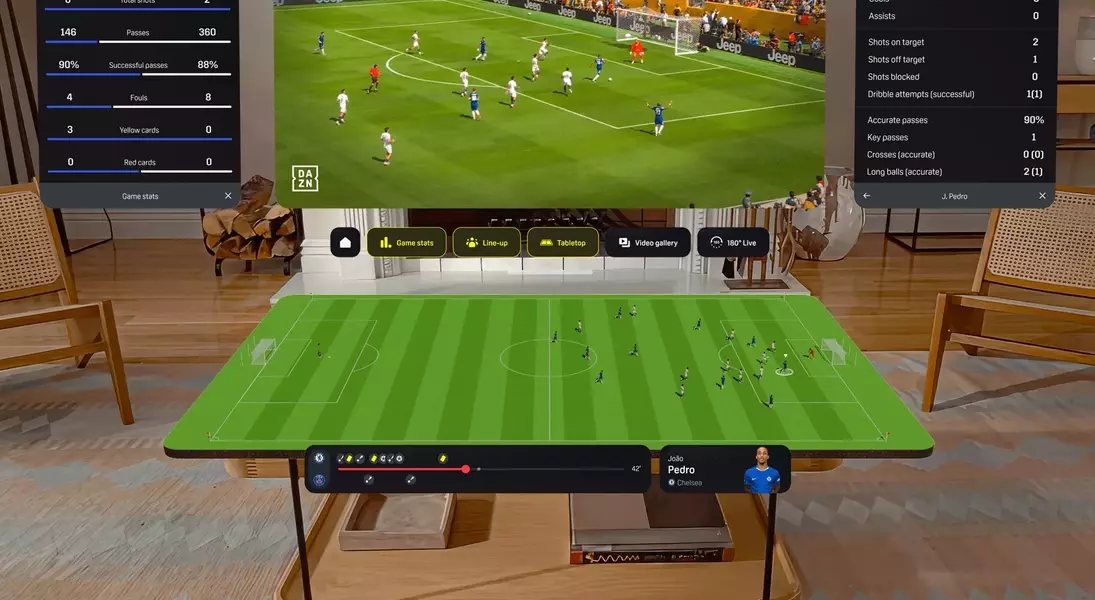
Beyond officiating, skeletal tracking is dramatically improving the live match experience for fans. Meta, in collaboration with sports entertainment platform DAZN, leveraged this technology during the Club World Cup to offer immersive coverage. Using the Meta Quest virtual reality headset, fans could not only access a 180-degree live video feed but also experience a virtual recreation of all 22 players on a 3D tabletop, synchronized with the live game, akin to a real-life Subbuteo match.
Marc Lange, Executive Vice President of Product Marketing and Strategy at DAZN, highlights the transformative potential: 'Nothing stops you from choosing any viewing angle that you want, because it’s digitally created using data — there’s no fixed camera angle.' This capability allows users to select specific perspectives, such as replaying a goal from the striker's or goalkeeper's viewpoint. DAZN's partnership with Meta has opened doors for future collaborations with top European leagues, aiming to deliver similarly immersive fan experiences. The rapid evolution of this technology suggests that a nearly perfect, customizable representation of a player's actions from any desired angle is becoming a tangible reality.
Genius Sports is pushing the boundaries further with its latest innovation: 3D mesh tracking. This technology extends beyond the 29 skeletal points, utilizing iPhones to analyze up to 10,000 surface points on each player over 200 times per second. This creates a high-resolution 'digital twin' of the game, allowing for immersive 3D replays that enable viewers to experience the game from the precise perspective of a specific player during a key action. Fleckenstein draws a parallel to other sports, mentioning LeBron James' use of their technology to refine his shooting, illustrating its potential for individual player development.
Coaches and analysts are also benefiting immensely. Sky Sports' Monday Night Football, for instance, showcased an early version of this technology when Jamie Carragher analyzed a goal from a player's perspective, offering insights into decision-making. This allows coaches to engage players in meaningful conversations about their choices during real-time play, bridging the gap between external observation and the player's on-field experience. Danish Superliga club Viborg and Nottingham Forest have actively adopted Genius's 3D replays to facilitate discussions between players and staff, particularly for set-piece analysis, by visualizing players' body shapes.
The potential for skeletal tracking extends even to the transfer market. While clubs currently integrate traditional tracking data with event data for recruitment, skeletal tracking offers an unparalleled level of detail for player profiling. Imagine identifying an old-school 'back-to-goal' striker capable of holding off defenders using their elbows and advancing play, all through data analysis. However, widespread access to such detailed data remains a challenge. FIFA, in collaboration with tracking company Hawk-Eye Innovations, is actively working to transform these dense datasets into actionable insights for various stakeholders. Their innovation program, in partnership with the Federal Institute of Technology Zurich, has even launched a competition to generate skeletal tracking data solely from broadcast footage, aiming to democratize access to this powerful analytical tool. The ability to process such granular data from a single game with astonishing accuracy is now well-established, tracking every intricate movement a player makes. The only real constraint to further progress lies in the limits of human imagination.
This groundbreaking technology, already demonstrating its capabilities in enhancing player analysis and fan engagement, is set to continue its transformative journey within football. The ongoing advancements promise a future where tactical insights are sharper, player development is more targeted, and the matchday experience is more immersive than ever before, marking a new chapter in the sport's analytical evolution.
