
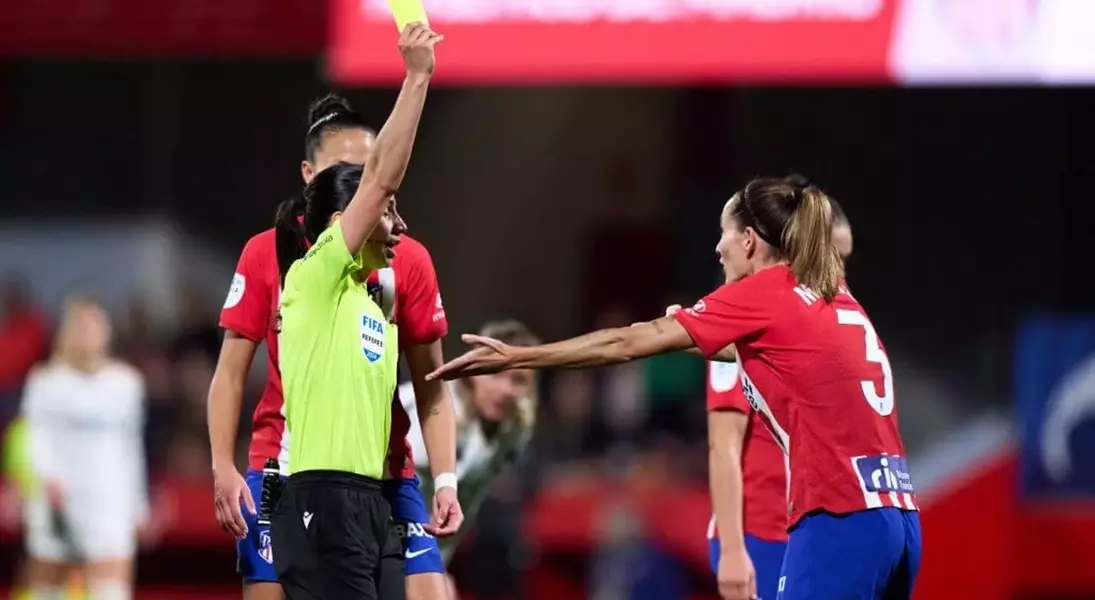

Liga F, Spain's premier women's football league, has embraced a new video review system, dubbed 'VAR-lite', marking a significant step towards enhancing fairness and reducing officiating errors. This innovative approach, known as Football Video Support (FVS), diverges from traditional VAR by integrating a unique challenge system for teams and conducting reviews directly on the field. Despite its promise of improved accuracy and cost-efficiency, the initial implementation has sparked discussions about its impact on game momentum and the length of decision-making processes. As the league adapts to this technological shift, stakeholders are actively seeking ways to refine the system, ensuring it achieves its objectives without compromising the pace and enjoyment of the game.
The introduction of the FVS system in Liga F represents a pivotal moment for women's football, aiming to elevate the standard of play through precise officiating. However, its novel features, particularly the on-field review setup and the absence of multiple camera angles, present distinct challenges. While the system has already demonstrated its capability to correct crucial decisions, the time taken for these reviews has become a focal point of concern. The ongoing dialogue among players, coaches, and league officials highlights a collective desire to streamline the review process, ensuring that the benefits of video technology are fully realized while maintaining the dynamic nature of football.
Understanding Liga F's Innovative Video Review System
Liga F has rolled out a distinct video review system, termed Football Video Support (FVS), which differs significantly from the conventional VAR. This 'VAR-lite' approach is designed to intervene in key game situations such as goals, penalties, offsides, and cases of mistaken identity. Unlike traditional VAR, FVS does not utilize a dedicated VAR room; instead, the on-pitch referee directly reviews incidents on a monitor near the technical area, aided by an audiovisual technician. A unique aspect of this system is the challenge mechanism, granting each team up to two review requests per match. Coaches can signal a challenge using a colored card (blue for home, green for away) and twirling a finger. If a challenged decision is overturned, the team retains its challenge. Notably, all goals are subject to automatic review by the on-pitch official, irrespective of a challenge, and the system currently lacks semi-automatic offside technology or multi-angle camera replays, a limitation attributed to varying stadium infrastructure across the league. This cost-effective solution aims to enhance decision accuracy while acknowledging the financial and infrastructural realities of the league.
The FVS system's inaugural phase has brought about both improvements and points of contention. On its first day of use, the system was activated 39 times, leading to the correction of one red card and the disallowance of three goals due to offside, underscoring its potential to rectify critical errors. However, matches like Barcelona Femeni's dominant win against Alhama CF saw numerous interventions (12 in total), including lengthy reviews that disrupted the game's flow. For instance, a five-minute delay for a goal review, originating from a contentious play at the opposite end of the field, drew boos from spectators, highlighting fan frustration with extended pauses. Another incident in a match between Granada and Levante involved a four-minute review of a penalty claim that ultimately led to a score-altering decision, sparking debate over its fairness. These early experiences indicate that while FVS is effective in identifying and correcting significant mistakes, the prolonged review times and the limited technological support, such as the absence of multiple camera angles and semi-automatic offside detection, can impede game rhythm and generate controversy. As the league progresses, refining the speed and efficiency of these reviews will be crucial for the system's acceptance and success.
The Impact and Future of FVS in Women's Football
The introduction of the Football Video Support (FVS) system in Liga F has been largely welcomed by participating clubs as a positive step towards modernizing officiating and ensuring greater fairness in the game. Despite this general approval, a prominent concern among players and coaches alike is the system's impact on game flow. Lengthy review periods frequently interrupt play, making it challenging for athletes to maintain their momentum and concentration. Players, including Barcelona's Caroline Graham Hansen and Laia Aleixandri, have voiced the need for quicker processes, acknowledging that while the tool is beneficial for fairness, its current implementation leads to significant breaks. Coaches, such as Barca's Pere Romeu, echoed these sentiments, expressing regret over the disruptions for both fans and players and advocating for accelerated review times. This shared perspective underscores a collective desire for the system's refinement to balance its advantages in decision accuracy with the need to preserve the game's intrinsic dynamism. The consensus is that FVS, while promising, requires further optimization to fully integrate into the match experience without detrimental effects.
Officials from Liga F and the Spanish football federation (RFEF) have acknowledged the initial challenges and are committed to refining the FVS system. Liga F president Beatriz Alvarez candidly admitted that while the implementation is a positive step, there are "details that need to be ironed out," particularly concerning the prolonged wait times during reviews. The league aims to reduce these four to five-minute pauses, which disrupt the natural rhythm of the game. Discussions are ongoing with Spain's referees association (CTA) to enhance the system's attractiveness and efficiency. Beyond Liga F, this 'VAR-lite' technology is also being trialed in other football contexts, including the men's third tier (Primera Federacion) in Spain, previous U-17 and U-20 Women's World Cups, and Italy's Serie C. FIFA's perspective, as articulated by Pierluigi Collina, chairman of the FIFA referees committee, is that FVS serves as a viable alternative for leagues or matches with limited financial resources or camera infrastructure, rather than a permanent replacement for full VAR. It is designed to prevent "major mistakes" in environments where comprehensive VAR implementation is not feasible. This wider adoption and ongoing commitment to improvement suggest a future where such tailored video support systems could play an increasingly vital role in ensuring fair play across diverse football landscapes, provided that the operational aspects are continually optimized to enhance rather than hinder the match experience.
