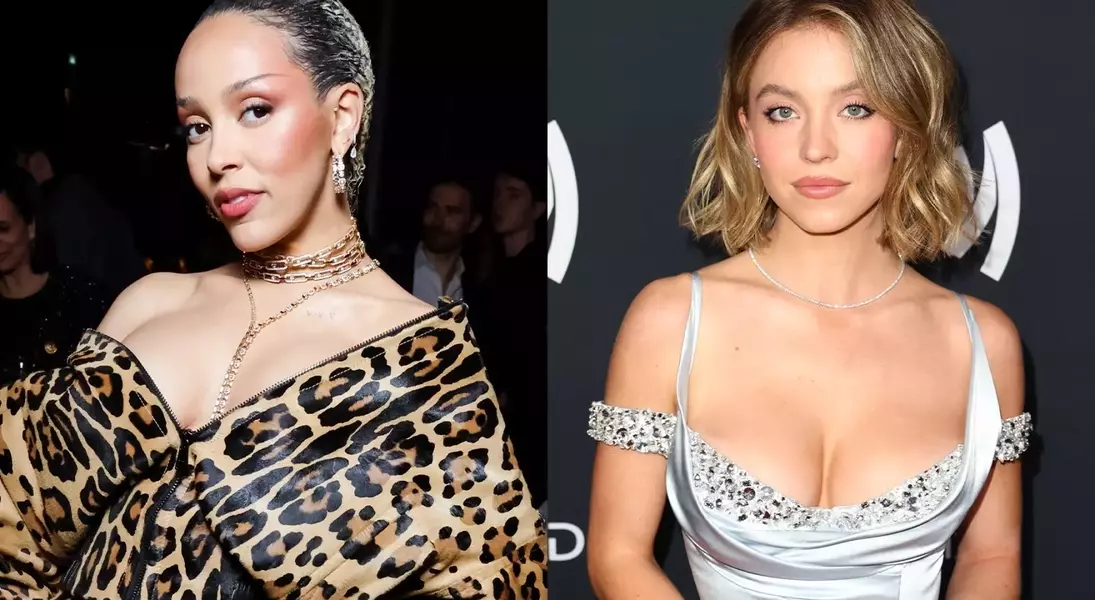
The recent American Eagle jeans campaign, featuring actress Sydney Sweeney, has become a focal point of discussion online, particularly after musician Doja Cat released a satirical video. This viral moment has not only amplified the original campaign's reach but also intensified the debate surrounding its controversial wordplay. The core of the issue lies in the campaign's tagline, which leverages the homophones 'jeans' and 'genes,' leading to accusations of subtle, and at times not-so-subtle, dog-whistling related to eugenics and white supremacy. This unexpected turn has transformed a seemingly innocuous advertisement into a broader cultural flashpoint, underscoring the complexities of public perception and marketing in the digital age.
Doja Cat's Viral Parody Ignites Renewed Controversy Over Sydney Sweeney's American Eagle Campaign
In a compelling turn of events on July 29, 2025, the dynamic pop artist Doja Cat, known for her sharp wit and engaging online presence, launched a TikTok video that has reverberated across social media platforms. Her target: the recent American Eagle jeans advertising campaign fronted by acclaimed actress Sydney Sweeney. Doja Cat's satirical rendition, delivered in a dramatically exaggerated Southern accent, mimicked Sweeney's ad copy, particularly the line exploring the playful yet contentious 'jeans' and 'genes' homophone. With a comedic twist, Doja Cat's version concluded with an amusingly drawn-out 'bleee,' contrasting with Sweeney's original 'blue.'
This parodic video quickly gained immense traction, accumulating nearly 11 million views and 2.5 million likes within its initial 24 hours. While the old adage suggests 'all press is good press,' this surge in viral exposure was likely not the kind American Eagle's marketing strategists had envisioned. The campaign, which initially aimed for clever wordplay, found itself entangled in a heated cultural debate, primarily due to the 'jeans/genes' tagline. Critics from progressive viewpoints have interpreted the pairing of blonde, blue-eyed Sweeney with this slogan as a veiled endorsement of eugenics and white supremacy. Conversely, certain conservative circles have celebrated the campaign, viewing it as a symbolic challenge to what they perceive as 'woke' ideology.
Neither Sydney Sweeney nor American Eagle have yet responded to the unfolding controversy, despite inquiries. Sweeney has previously addressed the unsolicited politicization of her physical appearance, stating to NME that there is little she can do. She affirmed her commitment to simply 'being me,' processing external information as she sees fit.
The Dual-Edged Sword of Virality: A Reflection on Modern Marketing and Public Discourse
The saga of Sydney Sweeney's American Eagle campaign and Doja Cat's viral response offers a poignant lesson in the unpredictable nature of modern marketing and the volatile landscape of public discourse. In an era where information spreads at lightning speed, even the most carefully crafted campaigns can be reinterpreted, satirized, and ultimately transformed into catalysts for broader societal conversations. This incident highlights the delicate balance brands must strike between creative advertising and potential misinterpretation, especially when themes touch upon sensitive social and political undertones. It also serves as a stark reminder that celebrity endorsement, while powerful, comes with the inherent risk of aligning with, or becoming embroiled in, existing cultural tensions. For consumers and creators alike, it emphasizes the importance of critical engagement with media and the perpetual evolution of meaning in the digital sphere.
