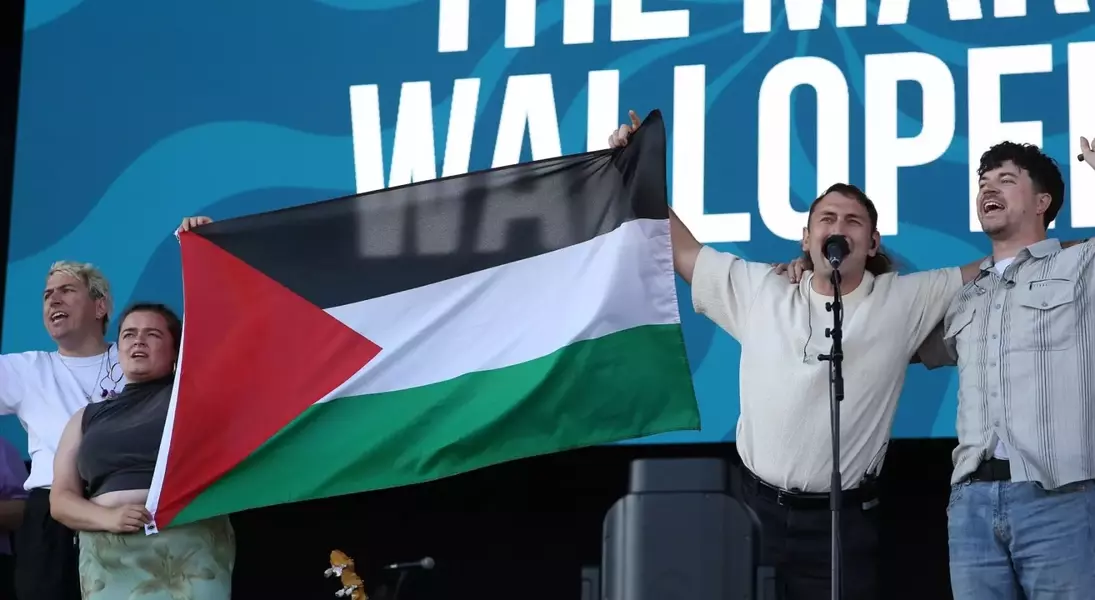
In a bold display of solidarity and artistic integrity, The Last Dinner Party announced their withdrawal from the Victorious Festival following the controversial curtailment of The Mary Wallopers' performance. This incident, rooted in The Mary Wallopers' public support for Palestine, has ignited a fervent discussion about political expression within music festivals. It underscores a burgeoning trend where musicians are increasingly leveraging their platforms to advocate for the Palestinian cause, often facing significant pushback. The festival's response to the incident has only intensified the debate, as the broader community reflects on the boundaries of free speech in cultural events.
Artists Take a Stand at Victorious Festival in Portsmouth
On a bright Friday, August 22, 2025, at the vibrant Victorious Festival held in Portsmouth, England, Irish folk band The Mary Wallopers took to the stage. Their set, however, was abruptly halted after they unfurled a Palestinian flag and vocalized calls for a “Free Palestine.” Eyewitness accounts and video footage shared by the band on social media reveal a festival crew member attempting to remove the flag, leading to the immediate cutting of the band's sound. The audience's response was a wave of boos, quickly followed by renewed chants of “Free Palestine” from both the band and the crowd when the flag was defiantly brought back out.
In the wake of this contentious event, on Saturday, August 23, 2025, the acclaimed band The Last Dinner Party declared their withdrawal from the festival. In an official statement released on Instagram, they expressed their outrage at the decision to silence The Mary Wallopers, emphasizing their refusal to endorse what they termed “political censorship.” The festival organizers, through a spokesperson, asserted that the show was terminated due to a chant perceived to have a “discriminatory context,” a claim vigorously denied by The Mary Wallopers. The Irish group insisted that the sound cut occurred directly after their call for a free Palestine, urging the festival to retract their statement.
This incident at Victorious Festival is not isolated. Throughout the current festival season, various artists across the globe have openly demonstrated their support for Palestinians. Notable instances include the Resistance Revival Chorus's prayer for Gaza at the Newport Folk Festival, and actor-comedian John C. Reilly waving a Palestinian flag from the main stage. Earlier in the year, Irish hip-hop group Kneecap faced similar challenges at Coachella, where their pro-Palestine messages were censored from livestreams and sparked considerable controversy during their performances. These events collectively highlight a pivotal moment where artists are confronting the delicate balance between artistic freedom and political sensitivity within the entertainment industry.
The Stage as a Platform: Beyond Entertainment
The recent events at the Victorious Festival serve as a potent reminder that the performing arts, particularly music, often transcend mere entertainment to become powerful arenas for social and political commentary. When artists utilize their creative platforms to highlight pressing global issues, they not only spark vital conversations but also challenge the traditional boundaries of what is deemed permissible within commercial spaces. This situation compels us to ponder the inherent responsibilities of festival organizers and, more broadly, the entertainment industry. Should these platforms prioritize neutrality, or do they have a moral obligation to facilitate, or at least not impede, expressions of humanitarian concern?
From a critical perspective, the attempt to silence The Mary Wallopers, coupled with The Last Dinner Party's principled stand, underscores a crucial tension. On one hand, organizers may seek to maintain a "safe" or "apolitical" environment to cater to a diverse audience and avoid controversy. On the other hand, artists and many audience members view the stage as a legitimate and necessary forum for addressing issues of justice and human rights. This clash of perspectives highlights a deeper societal dialogue about censorship, free speech, and the role of cultural institutions in a politically charged world. It prompts us, as consumers and participants, to question whether the pursuit of commercial viability should ever eclipse the freedom of expression, especially when the voices being amplified speak to profound human suffering.
