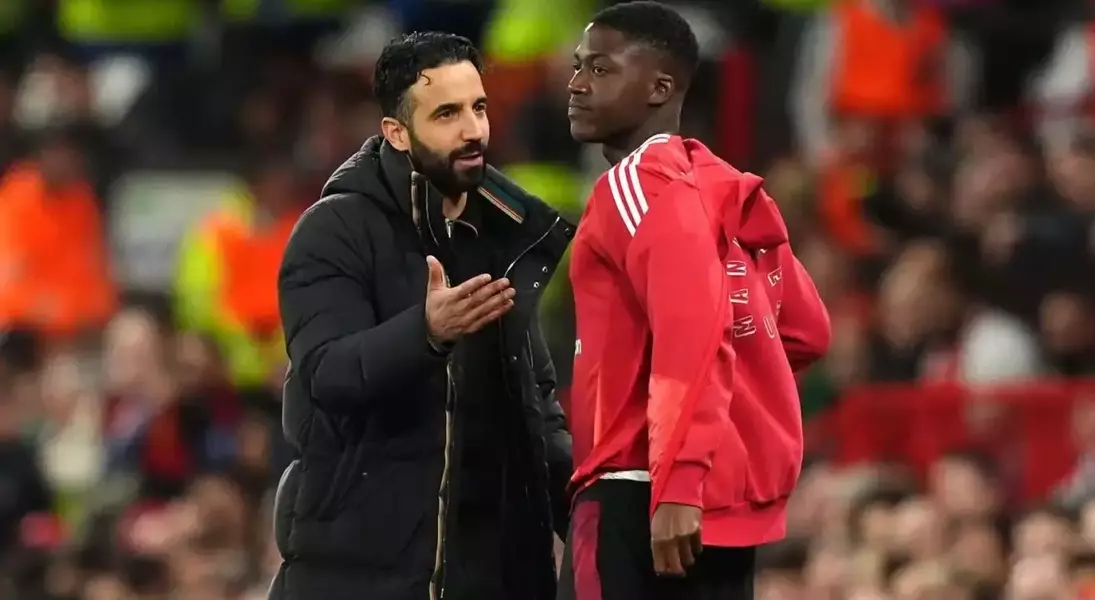
The leadership of Ruben Amorim at Manchester United has ignited significant debate, especially concerning player attitudes and perceived performance issues. Recent statements from both current and former players shed light on the complex dynamics within the squad. While many players maintain a public show of support for their manager, some insiders, including former Manchester United defender Phil Jones, suggest that not all individuals within the team are aligned with Amorim's vision. This internal discord is particularly evident in the situation surrounding young talent Kobbie Mainoo, whose reduced playing time and denied loan move have fueled speculation about systemic issues rather than individual shortcomings.
The conversation was initially sparked by Diogo Dalot's remarks following a surprising Carabao Cup loss to Grimsby Town, where he emphasized player accountability. Such sentiments are common in professional football, often serving to shield a manager from immediate public criticism. However, Phil Jones offered a more candid assessment, revealing that player dissatisfaction is not uncommon under any manager, even highly successful ones like Pep Guardiola. Jones drew on his own experiences, stating that what may seem like a manager's fault often turns out to be a player's own struggle with adaptation or personal challenges. He emphasized the importance of self-awareness and maturity for players to overcome these hurdles, rather than deflecting blame onto the coaching staff. According to Jones, attributing failure solely to the manager can be an easy, albeit often incorrect, conclusion for players.
However, the case of Kobbie Mainoo presents a more nuanced picture. Once a prominent figure for both Manchester United and the England national team, Mainoo has seen his role diminish significantly under Amorim, frequently finding himself on the bench. Despite his desire for more game time, especially in a World Cup year, a loan move was reportedly blocked by the club. This situation is particularly frustrating for Mainoo, as it appears to stem from a tactical system that doesn't fully utilize his strengths, rather than any perceived lack of effort on his part. Amorim's insistence that Mainoo 'fight for his place' is seen as a daunting task, given the formidable presence of captain Bruno Fernandes in a similar role.
Mainoo's dedication remains unwavering, as evidenced by reports of him undertaking additional training sessions, even after being overlooked for national team duty. This commitment underscores his desire to succeed despite the current challenges. Yet, the question lingers: is Mainoo truly 'the problem' in this scenario, or does the issue lie more broadly with the managerial approach and its impact on certain players? For Mainoo, and possibly others in similar positions, the prevailing sentiment is that the system or the manager's tactical preferences are the primary obstacles, rather than individual deficiencies. This ongoing tension between player responsibility and managerial influence highlights the complex dynamics at play within a high-stakes football environment like Manchester United.
