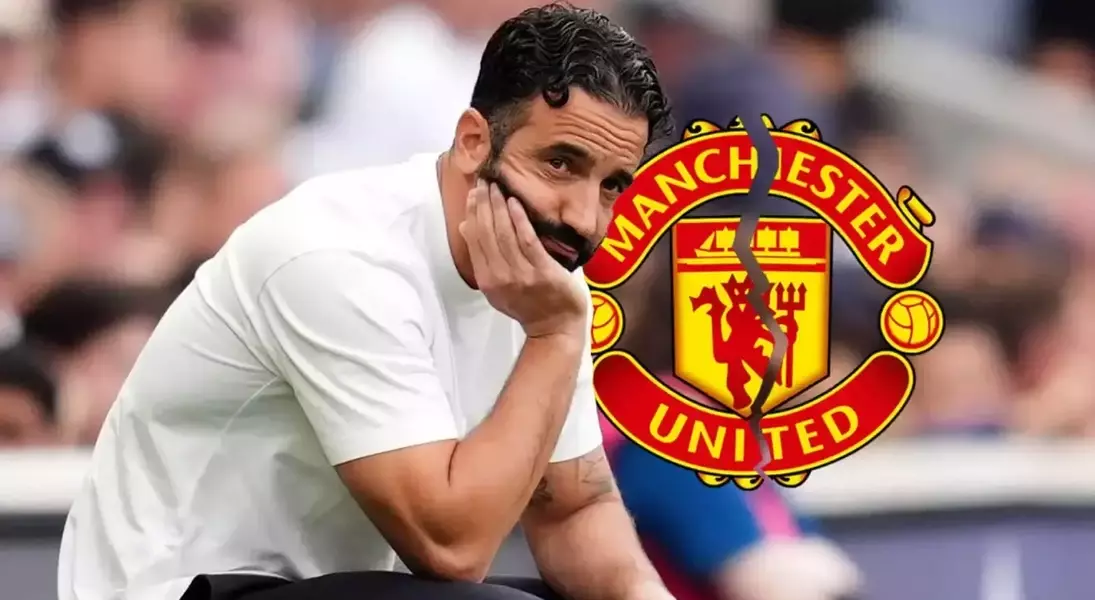
Manchester United manager Ruben Amorim is facing immense pressure as the team's performance continues to disappoint, sparking an intense debate about his future at the club. Despite considerable financial investment, the Red Devils are struggling to achieve consistent results, leading many, including football pundits, to question Amorim's steadfast adherence to his tactical philosophy. This unwavering approach, coupled with a string of poor performances, has fueled speculation that a change in leadership might be the only viable path forward for the club.
Former Manchester United captain Roy Keane has been vocal in his criticism, asking pointedly, \"How long do you keep waiting? We keep making excuses, but at some stage you go ‘When are we going to see the signs?’\" This sentiment encapsulates the growing frustration among fans and analysts alike. There is a prevailing sense that the team lacks a clear direction, and the belief that Amorim will suddenly find a winning formula is increasingly viewed as a distant fantasy. The team's inability to adapt or show significant improvement suggests a fundamental disconnect between the manager's vision and the team's execution.
Amorim, for his part, has remained defiant, stating, \"I won’t change my philosophy. If they [United hierarchy] want it changed, you change the man.\" This unwavering stance, while perhaps a testament to his convictions, has only intensified the debate. His remarks hint at a potential standoff with the club's hierarchy, suggesting that he is not only unwilling to compromise on his tactics but is also implicitly challenging the club to make a decision about his role. This defiance, in the face of mounting criticism and poor results, has led some to believe that Amorim might be deliberately provoking his dismissal to secure a substantial severance package, adding another layer of complexity to an already tumultuous situation.
The financial implications of a managerial change are significant. Manchester United has already invested hundreds of millions of pounds into the squad under Amorim's leadership, and another change would entail further substantial costs, both in compensation for the departing manager and in securing a new one, along with potential new player acquisitions. The club faces a difficult dilemma: can they afford to absorb another massive financial hit and rebuild yet again, or can they afford to continue with a manager whose methods appear to be failing?
The statistics paint a grim picture. Following a demoralizing defeat in the Manchester derby, United has collected only four points from their first four Premier League matches this season. This extends Amorim's record to an average of precisely one point per Premier League game since his appointment. Such a record places Manchester United among the league's bottom teams, with only West Ham and Tottenham performing worse in the calendar year table. The comparison with Tottenham, who have already benefited from a managerial change, further highlights the urgency of United's predicament.
A deeper analysis reveals that Amorim's limited success has largely come against historically weaker, newly promoted teams. Out of his mere eight Premier League victories, three were against teams that were subsequently relegated last season, and his sole win this season came against another newly promoted side. Against established Premier League opponents, his record is abysmal, with only four wins from 26 games. This suggests a fundamental flaw in his system when facing resilient and organized opposition.
The core of the problem appears to lie in the midfield. Despite significant investment during the summer transfer window, the squad seems ill-suited to Amorim's preferred system. The focus has often been on the defensive line, but while United may have sufficient numbers at the back, they are frequently bypassed with alarming ease. Conversely, creating scoring opportunities at the other end against fewer defenders proves to be an insurmountable challenge. The midfield's lack of agility and mobility, crucial for Amorim's tactical approach at Sporting, is severely hindering United's ability to transition effectively, both defensively and offensively. Players like Manuel Ugarte have struggled to integrate, Kobbie Mainoo's confidence has reportedly been shattered, and the decision to sell Scott McTominay now appears to be a monumental error, given his potential suitability for the current system. Furthermore, the misdeployment of star player Bruno Fernandes in a role that diminishes both his individual performance and the team's overall effectiveness is a glaring issue.
Adding to the turmoil, reports suggest that Amorim has had significant fallouts with numerous players, many of whom have subsequently thrived after leaving the club. Andre Onana, for instance, has found renewed form at Trabzonspor after departing Old Trafford. Conversely, players who arrive at United with strong reputations often see their performances decline dramatically. This 'reverse alchemy' indicates a systemic problem that is negatively impacting both individual players and the club as a whole, with the manager bearing the brunt of the responsibility.
While Manchester United fans have endured numerous disappointments in the post-Sir Alex Ferguson era, the current situation feels particularly dire. The pervasive sense that things cannot possibly get any worse for the club underscores the depth of the crisis. The club is at a critical juncture, facing decisions that will undoubtedly shape its immediate future and determine whether it can emerge from this protracted period of underperformance.
