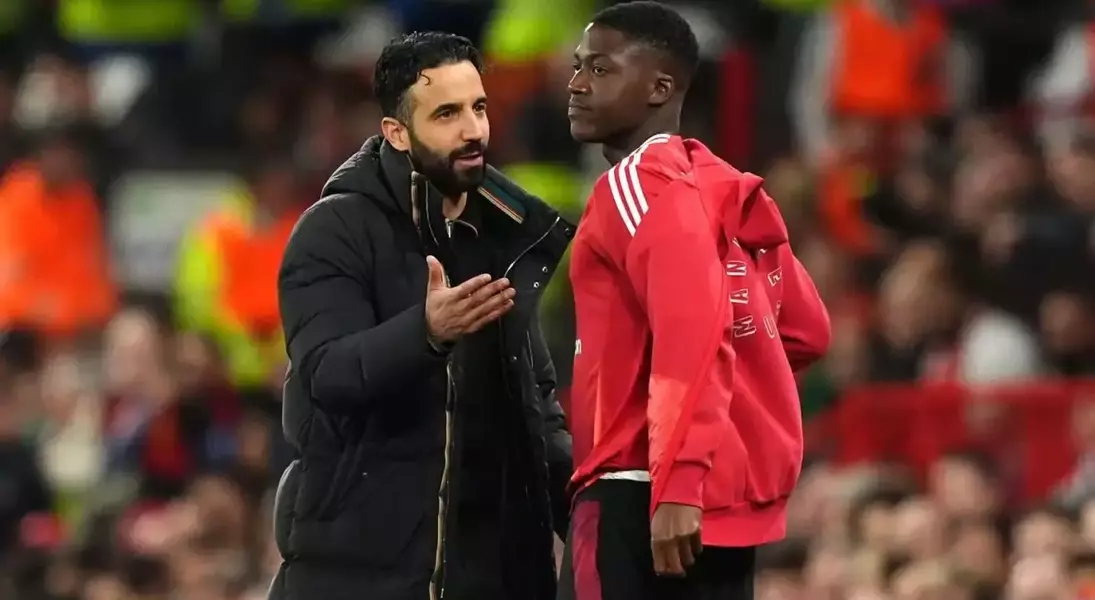
Ruben Amorim, the head coach of Manchester United, recently shed light on the circumstances surrounding young talent Kobbie Mainoo's desire for a temporary transfer. Mainoo, feeling a lack of consistent first-team action at the season's outset, had expressed an interest in a loan spell, a request that was ultimately turned down by the club. Amorim's remarks also touched upon the reported concerns from the club's hierarchy regarding his public statements, adding another layer to the unfolding narrative at Old Trafford.
Amorim Addresses Mainoo's Future Amidst Board Scrutiny
In a recent press conference held in the lead-up to Manchester United's significant match against Manchester City, manager Ruben Amorim provided clarity on a developing situation involving midfielder Kobbie Mainoo. Mainoo, a promising young player, had expressed a desire to seek a loan move during the recent transfer window, driven by his absence from the starting lineup in the initial three Premier League fixtures. His request, however, was not granted by the club.
Amorim stated, \"Like many players, he seeks more playing time.\" He revealed that he had not engaged in discussions with Mainoo prior to the transfer window's closure, but had since spoken with the player this week. \"I didn't want Kobbie Mainoo to think I was only conversing with him to retain him,\" Amorim explained, emphasizing his genuine belief in the midfielder's abilities. Despite acknowledging Mainoo's current standing, Amorim stressed that he envisions a much higher ceiling for the player. \"Some believe Kobbie Mainoo has already reached his peak. I, however, see considerable room for his development,\" he asserted, suggesting that for Mainoo, his current contributions are merely a stepping stone. Amorim concluded by assuring that Mainoo, like other squad members, would be given opportunities to prove himself.
Adding to the complexity of the situation, reports from earlier this week indicated that the Manchester United board was displeased with Amorim's conduct, specifically his \"emotional public pronouncements.\" It was reported that Amorim's public suggestion that Mainoo would be vying for a starting position with Bruno Fernandes had inadvertently created difficulties during the crucial final days of the summer transfer window. Jason Wilcox, a key figure at the club, reportedly had to intervene to convince Mainoo to remain at Old Trafford and abandon his pursuit of a loan. This incident was perceived by some within the club as an \"unwise and unnecessary action\" by Amorim, lacking both emotional intelligence and an understanding of Manchester United's rich tradition of nurturing homegrown talent.
When questioned about Mainoo's reaction to the current circumstances, Amorim noted, \"He might not be accustomed to competing for his spot.\" He described Mainoo as a \"very good kid\" eager to learn, acknowledging the difficulty of encouraging players to embrace new approaches. Drawing a parallel, Amorim cited Vitinha, who struggled for playing time at Wolverhampton but has since become a top midfielder, implying that unforeseen developments can shape a player's career. He highlighted a tactical shift under his management, moving away from the previous focus on transitions, which had allowed Mainoo to dictate the pace of play. Now, with other players capable of calming the game, Amorim admits to having higher expectations for Mainoo. He mused, \"Perhaps if I were to start him more frequently, Kobbie Mainoo would play and become indispensable.\" Ultimately, Amorim affirmed that his decisions are guided by his current instincts and vision for the team, while acknowledging Mainoo's past successes, including starting in a European Championship final with other talented players like Foden and Palmer.
This ongoing narrative highlights the intricate balance a football manager must strike between player development, team performance, and managing club expectations. Amorim's commitment to Mainoo, despite the perceived missteps, underscores his belief in the young player's ultimate potential, even as he navigates the external pressures and internal dynamics of a top-tier football club.
