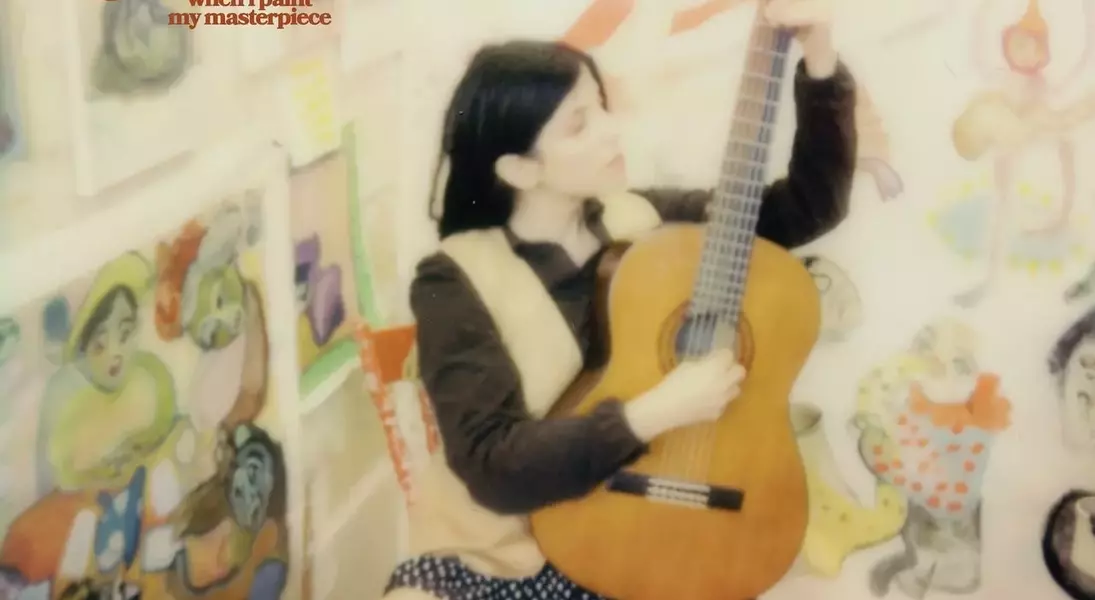
In her latest musical offering, 'when i paint my masterpiece', the Montreal-based artist Alexandra Levy, performing as Ada Lea, presents a profound exploration of the creative act, emphasizing the journey of artistic endeavor over the destination. This album, her third studio release, emerges as a collection of gentle, folk-influenced compositions that celebrate the nuances of everyday existence and champion the virtue of humility. It marks a significant evolution in Levy's approach, born from a period of rest and renewed artistic exploration, demonstrating a mature embrace of the process of creation across various mediums, including songwriting, painting, and poetry.
Levy's artistic philosophy, which posits that true creative success lies in the focus on the process rather than fixation on the finished product, profoundly shapes 'when i paint my masterpiece'. After the demanding cycle of writing, recording, and touring her previous albums left her feeling drained, Levy wisely stepped away from music. During this hiatus, she immersed herself in studying painting and poetry, and also took on teaching roles. This period of artistic cross-pollination evidently infused her new work with a distinct lightness and ethereal quality. Many tracks possess a flowing, almost improvisational feel, characterized by understated instrumentation. For instance, 'midnight magic' features Levy's layered harmonies set against a leisurely piano, while 'it isn't enough' foregoes traditional song structures, opting for a tender melody supported by simple guitar and percussion, all contributing to a more tranquil atmosphere than her earlier, more frenetic releases.
While her 2021 release, 'one hand on the steering wheel the other sewing a garden', explored the complexities of nascent love and the disorienting impact of heartbreak, 'when i paint my masterpiece' delves into broader philosophical themes concerning human connection, careful observation, and life's ultimate purpose. Lines from 'it isn't enough' such as \"You give and you take/You try and you fail/You live and you love\" encapsulate this reflective turn. Similarly, in 'just like in the museum', she acknowledges, \"It is what it is,\" before adding, \"We laugh when it's good/And cry when it's not.\" However, the deliberately sparse production sometimes renders these insightful reflections feeling like preliminary sketches awaiting a more vibrant realization.
Nevertheless, this unpretentious methodology frequently allows Levy's remarkable talent for uninhibited narrative to shine. Her songs often unfold with a spontaneous, almost stream-of-consciousness flow, gaining momentum as they progress. 'baby blue frigidaire mini fridge' exemplifies this, starting with the titular object and gradually expanding its scope to encompass a lost love, distant mountains, and eventually, a cosmic perspective on \"our old time souls/This old-time moon.\" Another piece, 'snowglobe', vividly portrays a lively gathering, detailing clothing, contributions, and conversations before Levy's poignant exclamation, \"Look at us/Sitting 'round the kitchen table/Thinking that/We are made of something special,\" delivered with a blend of irony and affection.
A significant portion of the album was recorded in a singular room with a small ensemble, fostering a live and spontaneous energy in rural Ontario. This intimate recording environment contributes to some truly captivating moments, such as the subtle yet powerful distorted guitar riff in 'something in the wind' or the expertly managed tension in 'down under the van horne overpass'. Levy's wit also surfaces, notably in 'bob dylan's 115th haircut', where she playfully asserts her own creative capabilities, even humorously suggesting that Bob Dylan himself wouldn't have conceived of such a song. This humorous self-assurance underscores Levy's conviction that artistic achievement is not about external validation or comparison, but rather about honoring one's unique circumstances and consistently engaging with the creative impulse.
Ultimately, 'when i paint my masterpiece' encourages listeners to view the act of creation itself as the masterpiece. Levy's journey of stepping back, learning, and re-engaging with her art exemplifies a profound dedication to the process, highlighting that every moment of creative commitment contributes to the unfolding of one's artistic magnum opus.
